Sertis CEO Shares AI and Data Strategy Insights at IRIS SKILLFEST 2025


On October 22, 2025, IRIS SKILLFEST 2025 brought together leading executives from Thailand’s technology and AI under the theme “Modern Capability #5: Smart Digital, Data, AI Strategy.”
The discussion explored how AI and data strategies can move beyond theory and evolve into actionable frameworks that deliver measurable business value.
Mr. Tee Thuchakorn Vachiramon, CEO of Sertis, joined the panel alongside Siriwat Vongjarukorn (MFEC), Dr. Virote Siriratanaruk (Advance Web Service - AWS), Mr. Chonladet Khemarattana (Thai Fintech Association and Webull), and Worawat Paarporn (Processing Center Company – PCC).
Moderated by Vee Sirasoontorn, CEO of Primo, the session examined Thailand’s evolving AI landscape. Highlighting the structural, cultural, and human capabilities that define sustainable AI transformation.
1. Digital Foundation & Data Power: The groundwork for AI success
Before organizations can unlock the full potential of AI, they must first strengthen their data foundation.Even the most advanced model cannot perform without high-quality, well-governed, and connected data.
Many enterprises continue to undervalue the role of Data Governance, System Integration, and Cybersecurity, despite these being the cornerstones of scalable AI.
Organizational data often remains fragmented and without clear ownership, limiting its ability to generate business insight.
Real-time, connected data has become the modern “oil” that fuels digital strategy and agile decision-making.
Mr. Thuchakorn, CEO of Sertis, emphasized that organizations achieving the strongest results with AI are those that prioritize data readiness early in their transformation journey. By developing clear structures and connected systems, enterprises can transform their data assets into scalable, value-driven use cases that deliver sustainable impact.
“Data governance may take time and resources, but if you don’t start with it, you’re effectively closing the door on AI creating value.”

The moderator further noted the growing demand for professionals in data infrastructure and data engineering, which are critical for maintaining the pipelines that sustain enterprise AI systems. Mr. Thuchakorn, CEO of Sertis, added that Data Engineers, AI Engineers, and Machine Learning Engineers continue to play a pivotal role in ensuring enterprise data is well-prepared, connected, and scalable to support the next phase of AI transformation.
2. AI Impact & Value Creation: Turning Investment into Outcomes
AI investments generate tangible value only when organizations identify where technology delivers the greatest impact, rather than adopting it as a trend or experimental initiative.
AI adoption often shows its earliest and most measurable results in supporting operations, such as IT or back-office functions, where automation drives immediate gains in productivity and process efficiency.
To deliver consistent outcomes, AI models must undergo continuous training to reflect each organization’s context, data environment, and operating realities.
Return on investment should be viewed comprehensively, by considering both financial and operational impact, including time savings, improved accuracy, and reduced workload.
An example from the financial and investment sector illustrated this principle.
AI has been applied across the entire customer lifecycle, from KYC and digital onboarding to data validation, customer segmentation, and domain-trained chatbots that analyze market movements in real time while minimizing the risk of hallucination.
Mr. Thuchakorn, CEO of Sertis, noted that while many enterprises seek visible ROI from AI within twelve months, the most sustainable outcomes come from targeted implementation in areas that align directly with business value.
“AI delivers real ROI only when applied in the right area, not just because it’s new. For large enterprises, even a 1–3% improvement in efficiency can translate into significant value. For smaller businesses, automating IT support and reducing manual work can already represent a meaningful return.”
He added that the real challenge is not the technology itself, but how it is strategically applied. Many organizations pursue AI adoption for visibility or momentum, yet meaningful value is achieved only when AI is purposefully integrated with business goals and measurable performance outcomes.

3. Talent & Capability: People at the Core of Transformation
While technology may be ready, it is ultimately people who turn AI into reality within an organization. The foundation of success lies in cultivating an AI mindset and strengthening Digital Skills across every level of the workforce.
Younger professionals tend to adapt to AI more naturally, while experienced specialists are encouraged to remain open-minded, exploring and actively integrating new tools into their work.
Organizations do not necessarily need large teams of technical experts; what matters most is having people who truly understand how to apply AI effectively to create business value.
Viewing AI merely as a search or automation tool is no longer sufficient; it should be recognized as a collaborative partner that enhances productivity and decision-making across the organization.
Communication and prompting have become essential soft skills in the AI era, bridging the gap between human intent and machine capability.
Changing mindsets remains one of the most challenging aspects of AI transformation, requiring time, understanding, and a genuine commitment to continuous learning and improvement.
During the discussion, the speakers also shared three common pitfalls that organizations should avoid when adopting AI:
Model Trap: Relying on a single, generic AI model instead of choosing or fine-tuning models for specific business domains.
Use Case Trap: Applying AI to tasks that do not genuinely improve productivity — such as having AI summarize emails that were generated by AI in the first place.
Scalability Trap: Employees learn to use AI tools but apply them only for personal convenience, rather than integrating them into real business workflows.
The future of AI transformation will not be defined by the tools an organization possesses, but by how prepared its people are to learn, adapt, and apply those tools to achieve meaningful and measurable outcomes.
4. Key Takeaways: From Insight to Action
The transition into the AI era must begin with leaders who understand and take action themselves. Maximizing the value of AI is not only about the technology itself, but about understanding how it can advance organizational goals in a practical and sustainable way.
Leaders must take the initiative to understand and engage with AI directly, gaining a clear perspective on both its capabilities and its constraints.
AI needs to be a shared organizational priority, rather than the sole responsibility of one department. Every function should work together towards common transformation goals.
Connected and real-time data are essential for effective decision-making in modern businesses. Accurate, integrated, and accessible data empowers AI to produce insights that inform strategies with enhanced precision and reliability..
Organizations combining human insight and quality data will achieve lasting value, particularly as technology becomes more accessible, rather than those solely adopting new tech.
Mr. Thuchakorn, CEO of Sertis, shared a powerful closing thought:
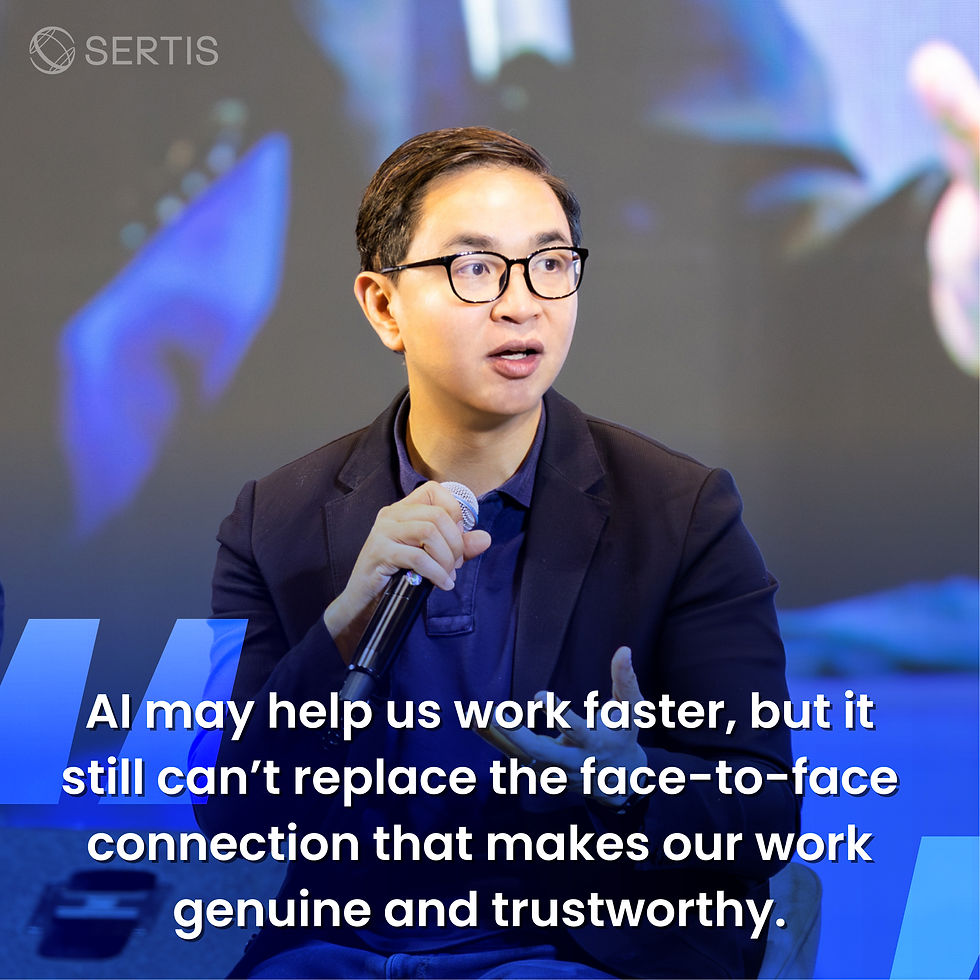
“AI may help us work faster, but it still can’t replace the face-to-face connection that makes our work genuine and trustworthy.”
The panel highlighted the transformative power of AI and data in today’s business landscape, emphasizing that the true driver of change lies in the partnership between technology and people who understand how to use it with value. As one of Thailand’s leading stages for innovation exchange, IRIS SKILLFEST 2025 brought together experts from across industries to shape a sustainable, AI- and data-driven future.
To learn more about what AI can do for your business, connect with us: https://www.sertiscorp.com/contact-us